






















123 Laundry Solutions · Commercial Laundry Buying Guide
Commercial Washer-Extractors: Types, Capacities & Buying Guide
Understand how commercial washer-extractors work, the differences between hard-mount and soft-mount machines, and the specifications to check before selecting equipment for a laundromat or commercial laundry operation.
Quick answer: Choose a washer-extractor by matching usable capacity, extraction performance, mounting requirements, utilities, controls, and parts support to your facility. Hard-mount and soft-mount designs have different installation needs; verify the exact model's specifications before purchasing.
What Is a Commercial Washer-Extractor?
A washer-extractor washes textiles and then spins them to remove water before drying or finishing. Commercial models are designed for repeated operation, but they differ substantially in capacity, controls, extraction speed, mounting system, and intended applications.
For a laundromat, payment controls and cycle selection may be central. For a hotel, healthcare laundry, or other staff-operated facility, workflow, load types, and throughput may matter more. The right machine depends on the actual operating environment.
Hard-Mount vs. Soft-Mount Washer-Extractors
Hard-mount (rigid-mount)
Typically requires anchoring to an appropriately engineered foundation. Site preparation, vibration loads, and manufacturer anchoring specifications are important purchase considerations.
Soft-mount (suspended)
Uses a suspension system to manage machine vibration. Installation requirements can differ from hard-mount machines, but a suitable floor, clearances, and site evaluation are still necessary.
| Question | Hard-mount | Soft-mount |
|---|---|---|
| Foundation | Check anchoring and structural requirements | Check floor-load and installation requirements |
| Vibration | Foundation design is especially important | Suspension helps manage vibration |
| Extraction | Varies by model | Varies by model; do not assume a fixed G-force |
| Best selection method | Review exact machine and site specifications | Review exact machine and site specifications |
Installation note: Never select a mounting type based on the name alone. Have qualified personnel review floor structure, anchoring, vibration, utility connections, and the manufacturer's installation instructions.
Choosing the Right Washer-Extractor Capacity
Capacity is commonly advertised as a dry-linen weight rating. It is only one factor in throughput: the fabric mix, cycle duration, extraction performance, available drying capacity, and number of loads per day also matter.
| Capacity range (illustrative) | Questions to consider |
|---|---|
| 20–35 lb | Will smaller frequent loads or customer-selected cycles be typical? |
| 40–60 lb | Does the workload require larger batches without overloading the machine? |
| 70–120 lb and above | Can the facility accommodate larger loads, handling requirements, utilities, and floor loading? |
These ranges are planning examples, not a statement that every manufacturer offers each size or that a size is appropriate for a particular industry. For additional context, see the commercial washer capacity guide.
Specifications That Matter Beyond Capacity
- Extraction speed and G-force: Compare manufacturer-rated extraction performance; higher extraction may reduce retained water, but drying outcomes depend on the textile and process.
- Electrical supply: Verify voltage, phase, amperage, and local installation requirements.
- Water and drainage: Check inlet connections, water demand, drain sizing, and site plumbing.
- Mounting and footprint: Confirm foundation, floor loads, service access, and door clearances.
- Controls: Review available programs and coin or other payment configurations where relevant.
- Parts and service documentation: Confirm support for the exact model and serial number.
Brands and Washer-Extractor Models to Compare
Start with the manufacturer's equipment family, then compare individual product listings and manuals. The links below are examples for further research, not claims of current stock or verified specifications.
Milnor
Explore new Milnor front-load washers and refurbished Milnor washers. Product examples include MCT18E4, MCT27E5, and MCR36E4.
Continental Girbau
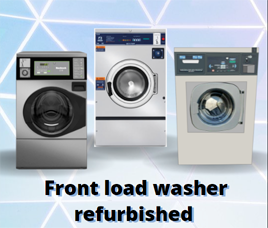
Explore the Continental Girbau equipment hub, refurbished front-load washers, and replacement parts. A specific refurbished example is the Continental Girbau EH020 20 lb washer-extractor, listed as a soft-mount, high-spin model with 120V single-phase power. Check the individual listing for its condition, specifications, and availability.
Other manufacturers may offer washer-extractors suited to different workloads. Use the commercial washing machine brands comparison for broader context.
New vs. Refurbished Washer-Extractors
New equipment may offer a different combination of model availability, controls, documentation, and warranty terms. Refurbished equipment may lower initial purchase cost, but its value depends on condition, testing, included components, parts support, and written sale terms.
For refurbished machines, ask which parts were inspected or replaced, whether a full operating cycle was tested, and whether photographs show the actual unit. Read the buying guides for additional evaluation resources.
Washer-Extractor Buying Checklist
- Identify your expected load sizes, textiles, and loads per day.
- Confirm the machine's exact model, rated capacity, and condition.
- Determine whether the installation requires hard-mount or soft-mount equipment.
- Verify floor, anchoring, access, and clearance requirements with qualified personnel.
- Check voltage, phase, water supply, drainage, and any other utilities.
- Compare extraction performance and the downstream drying workflow.
- Verify controls, payment compatibility, and program requirements.
- Confirm parts availability, shipping terms, warranty, and total installed cost.
Buyer tip: Ask for the model's data plate and installation manual before committing to a purchase. Model-specific documentation should govern installation decisions.
Frequently Asked Questions
Is a washer-extractor the same as a front-load washer?
Many commercial washer-extractors load from the front, but the term emphasizes the machine's washing and high-speed water-extraction functions. Compare the exact equipment class and specifications rather than relying on the label alone.
Is a soft-mount washer-extractor always better?
No. Soft-mount and hard-mount machines have different installation characteristics. The better choice depends on the site, workload, available models, and manufacturer requirements.
Does higher G-force always mean faster drying?
Higher extraction can reduce retained moisture, but results also depend on fabrics, cycle settings, load size, and dryer performance. Compare the full process rather than a single number.
Can I buy a refurbished washer-extractor?
Yes, where inventory is available. Confirm the exact unit's condition, testing, compatible parts, utility requirements, and written purchase terms before ordering.
What information should I provide when asking for a quote?
Share your intended application, preferred capacity, expected daily laundry volume, available electrical and plumbing service, installation constraints, and whether you prefer new or refurbished equipment.